
The Mended Past
Time-Travel Drama
What if fixing the one thing you regret could change everything you love?
One chance to change the past may save the people you love—but rewriting history always comes with a price.
About the Book
What if you could go back and change the moment that altered everything?
For Steve, that moment has never left him.
Years after the drowning death of his six-year-old sister, Sarah, the loss still shapes the man he has become. But when an impossible opportunity allows him to return to the past, Steve is given the chance to do what he has imagined for years: save her.
Changing that moment should make everything better.
Instead, Steve discovers that history is far more fragile than he ever imagined.
Relationships shift. Lives change. People he once knew become different versions of themselves. And the future he returns to is no longer the one he remembers.
As Steve begins to understand the consequences of rewriting the past, he is forced to confront a devastating question:
How much are you willing to lose to save the person you never stopped loving?
The Mended Past is a time-travel drama about memory, grief, second chances, and the price of changing what has already happened.
Why I wrote The Mended Past

The Mended Past began with a question I think most people have asked themselves at some point:
What if I could go back and change one moment?
At first, that idea seems simple.
Fix the mistake.
Save the person.
Make the better choice.
But the more I thought about it, the more interesting the consequences became.
If you changed one painful moment in your past, what else would disappear with it?
Which relationships would never happen?
Which memories would no longer exist?
And what if saving one person meant losing someone else you had come to love?
That tension became the heart of The Mended Past.
The time travel may drive the plot, but the real story is about grief, memory, love, and the impossible choices that come with being given one more chance.
Read an Excerpt:
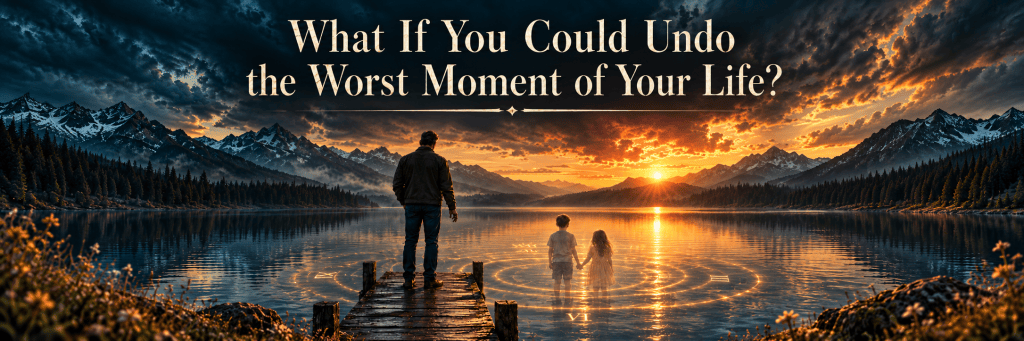
Chapter 1
…I stood up and nudged the cards aside. “Come on. Let’s go outside.”
She hesitated. “Mom said—”
“Not the lake,” I said, before she could finish.
Her suspicion vanished on the spot. “Where, then?”
“I don’t know. Just outside.”
That was enough. It was usually enough. We went out through the screen door and let it click shut behind us while our parents kept having the same argument they’d been having, in one form or another, all year.
The lake was bright under the sun, every small ripple throwing back the light. My father had laid the rules out clearly the day we arrived: no swimming without an adult, no going onto the dock alone, and absolutely, under no circumstances, touching the rowboat.
We knew the rules. That was the part people always tried to soften later — you were just children — as if knowing and understanding were the same thing, or as if either one had anything to do with what happened next.
Sarah followed close behind me on the path. “Where are we going?”
“Nowhere.”
“You said outside.”
“We are outside.”
“That’s dumb.”
“You’re dumb,” I said, and she shoved my shoulder, and I shoved her back light enough that it turned into a laugh instead of a fight.
I can still hear that laugh. Nobody warns you that grief works like that — that you don’t lose a person all at once, but in pieces, over years, until one day you realize you have to work to remember the exact sound of something that used to just be there. Her voice went first. Then the shape of her face when she smiled. She called me Stevie. Almost no one else ever had.
We reached the dock, and I stopped, watching the red rowboat rock gently against its rope. Sarah’s hand found my arm. “We’re not supposed to be down here.”
“I know.”
“Dad said.”
“I know what Dad said.”
She looked at the boat, then at me, curiosity working visibly against everything she’d been told. “Can we sit in it?”
I’ve never been able to settle that detail, even now. Some years I remember suggesting it. Other years I remember her asking. It doesn’t matter which. I was the one who climbed in first.
The boat dipped under my weight, and Sarah laughed, nervous. “Stop moving.”
“I’m not.”
“You are,” she said, stepping down after me, landing hard beside me on the bench.
For a few minutes, that was it. Two kids sitting in a small boat tied to a dock, on an ordinary morning, with no warning from anywhere that this was the last ordinary morning either of us was going to get.
Sarah leaned over the side. “I can see a fish.”
“Where?”
“Right there.”
“That’s a leaf.”
“It moved.”
“Leaves move, Sarah.”
“Not like that.”
The rope creaked against the post beside us, and I don’t know anymore whether the idea started right there or whether I’d already had it and just hadn’t admitted it to myself yet. Memory is not a reliable witness to the worst minute of your life. But I remember her whispering, “Don’t,” before I’d even touched anything.
“We’re not going anywhere,” I said, reaching for the line.
“You’re untying it!”
“Just a little.”
“Stevie, don’t.”
“We’ll stay right here. I promise.”
I worked the loop free, and the boat drifted six inches from the dock, then twelve. Sarah’s face did something complicated — alarm, then delight, arriving almost at the same time — and I remember feeling, for one full second, like I’d impressed her. That second became the central piece of evidence in the case I spent the next thirty-five years building against myself.
The gap kept widening. I reached back for the dock and missed it by a foot.
“Steve—” Her voice had lost its edge of play.
“It’s okay,” I said, which was a lie, and grabbed one of the oars. It was heavier than I expected, longer than my arms wanted it to be, and when I jammed it against the dock to push us back, the boat rocked hard enough that Sarah grabbed the side with both hands.
“Bring us back!”
“I am!” I said, fighting the oar. “Sit down!”
“I am sitting!”
“You’re moving!”
“You’re moving!”
What happened after that never comes back to me in order. The oar slipped and went into the lake. Sarah lunged for the gunwale, and the boat tipped further than it had any right to. I heard her scream, short and sharp, and then the water was around us, cold in a way that felt personal, like it had been waiting.
I went under. There was no sky, no dock, no sound — just green-black water and a rush of bubbles past my face and the specific, total silence of being somewhere that doesn’t care whether you get out.
When I broke the surface I was already screaming her name. “Sarah!”
She was right beside me. Or a few feet away. My memory has never been able to settle on the distance, and I’ve stopped trying to make it. Her eyes were wide, and she got one word out — “Stevie!” — before her hand found my wrist, small and freezing and locked on tight.
I tried to pull her toward me. The overturned hull came between us and caught my shoulder hard enough to knock the air out of me, and Sarah screamed again, and I felt her grip start to slide.
Hold on. Don’t let go.
And then I let go.
That’s how I remembered it, for thirty-five years. Her fingers slipping out of mine, and Sarah going under, and me diving after her into water that had no bottom I could find. I remember thrashing, blind, unable to tell up from down, unable to spot even a flash of yellow. I remember someone shouting from the shore — my father, maybe, or my mother — but in my memory the lake had already gone still, which it hadn’t, not really. That’s just how the moment set inside me. Still water. An empty hand. And the absolute certainty, arriving before I’d even reached the surface again, that I had let her sink.
Continue the Story on Amazon
Book Details
- Title: The Mended Past
- Author: Steven J. Gerwig
- Genre: Time-Travel Drama
- Formats: Kindle
- Available: Amazon
- Kindle Unlimited: Available
- Themes: Memory, grief, second chances, family, alternate timelines
Discover The Mended Past
One moment changed everything. One second chance may change even more.